Offensive security
We test your network the way an attacker would, and hand you a report you can act on.
One operator runs your engagement start to finish. That might be a focused penetration test or a campaign that plays out over months the way a real adversary does. We built our own platform to handle the tedious parts (the recon, the scanning, the evidence capture, the reporting) so the time on your network goes to judgment. You get a tester in the driver's seat, not a scanner pointed at your perimeter and left alone.
We use AI the way a careful professional should: to extend what one expert can cover, not to replace the expert. The judgment on your engagement is human. It stays that way.
See it in action
How the work runs, and what you get back.
How an engagement runs
- Deploy a runner. We install a small runner inside the network being tested and point it at our dashboard. It exchanges keys once, then reports in over an encrypted channel. The runner connects out, so nothing on your network has to accept a connection in.
- Agree the scope. Before anything runs, the engagement records what we are allowed to test: addresses, ranges and hostnames, with exclusions that always win. Every target is checked against that scope, and a target outside it is refused.
- Scan. The runner picks up the queued scans and runs them against the hosts in scope. Its output is kept with the engagement as evidence, then parsed into findings, with duplicates merged.
- Review and decide. The operator reviews each finding and records a decision: accepted risk, false positive, fixed, or needs a retest. Findings can be read grouped by issue or by host.
- Deliver the report. The reviewed findings are written up in the report, which you can read as a live HTML page or receive as HTML, DOCX, CSV, or JSON.
A realistic example simulated
- Map the attack surface. We start where an attacker would: scanning your internet-facing systems to see what is exposed and what software is running. No inside knowledge, just what anyone on the internet can reach.
- Find the hidden paths. We look for pages and endpoints that are not linked anywhere: old admin panels, forgotten uploads, backup files. These are the doors most people forget they left open.
- Get a foothold. We turn one of those weaknesses into a working shell on the web app. This is the moment the outside becomes the inside.
- Escalate to root. A first shell is usually low-privileged. We escalate to full control of the host, which gives us its stored credentials and its trust on the network.
- Move laterally. From the first host we map the internal network and reuse what we found. Flat networks and reused passwords let an attacker spread fast; segmentation is what slows this down.
- Take the internal network. Reused credentials get us onto the app and file servers, and from there a path to the domain controller. Each hop is a place your defenders could have cut the chain.
- Reach the crown jewels. We finish by proving the point: reaching the data an attacker would actually be after. We do not exfiltrate or damage anything. We show you the exact path we took, so you know precisely where to cut it.
Both are guided walkthroughs you can step through. The realistic example is one of the deliverables you receive: the interactive attack path that ships in your report. On a small screen, drag the map sideways to see every stage.
What you get
A report you can hand to your team and your board.
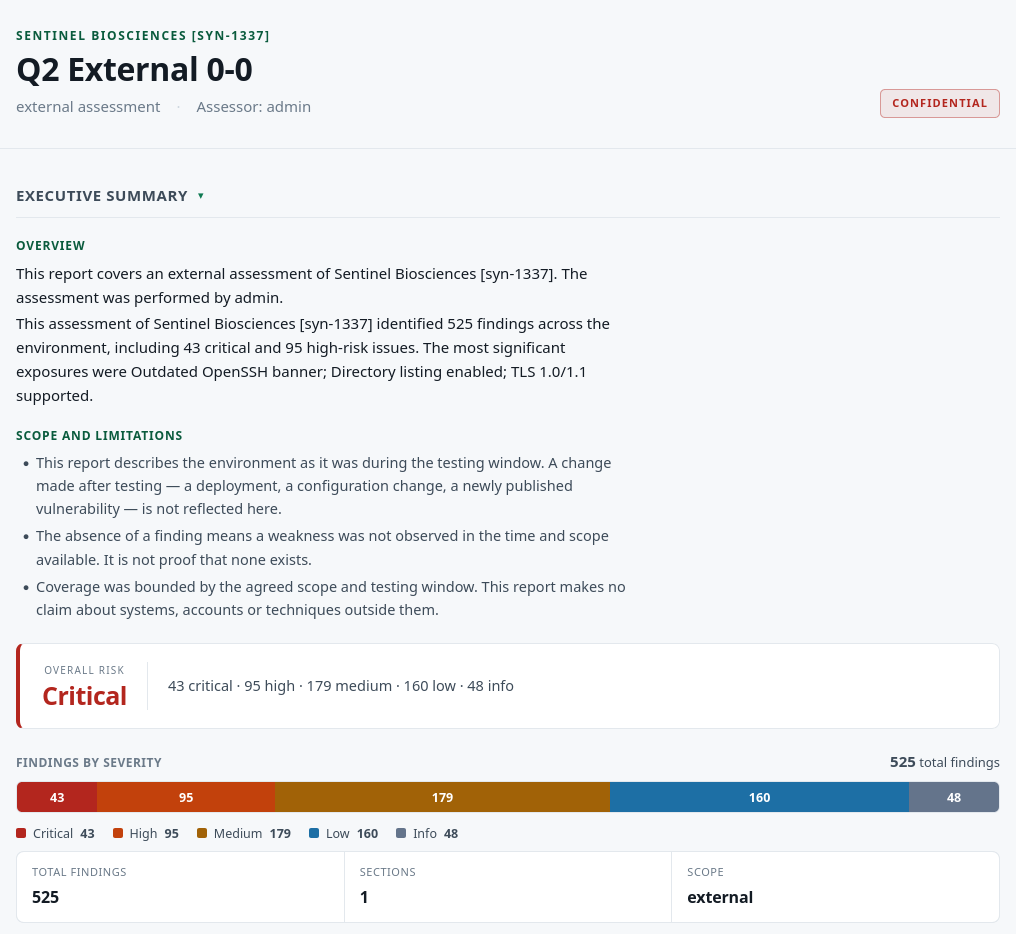
Every finding lands on one board, grouped, prioritized, and written up so it reads like a document, not a data dump. We export it in the format you need: HTML, DOCX, CSV, or JSON. The write-up is the part of a pentest that usually arrives late and rough. Our tooling is what changes that. On a sustained campaign, the same discipline carries into monthly journals and a final report, with findings mapped to MITRE ATT&CK so your team can trace each technique to what your defenses caught and what they missed.
The honesty promise
When we tell you an area is clean, it means we tested it. We report three outcomes for each area: we found something, we tested it and it held, or we ran out of time or couldn't reach it (and we say why). "Not tested" is its own column. It doesn't get dressed up as "nothing there."
What to fix first
We tell you which problems matter, in order.
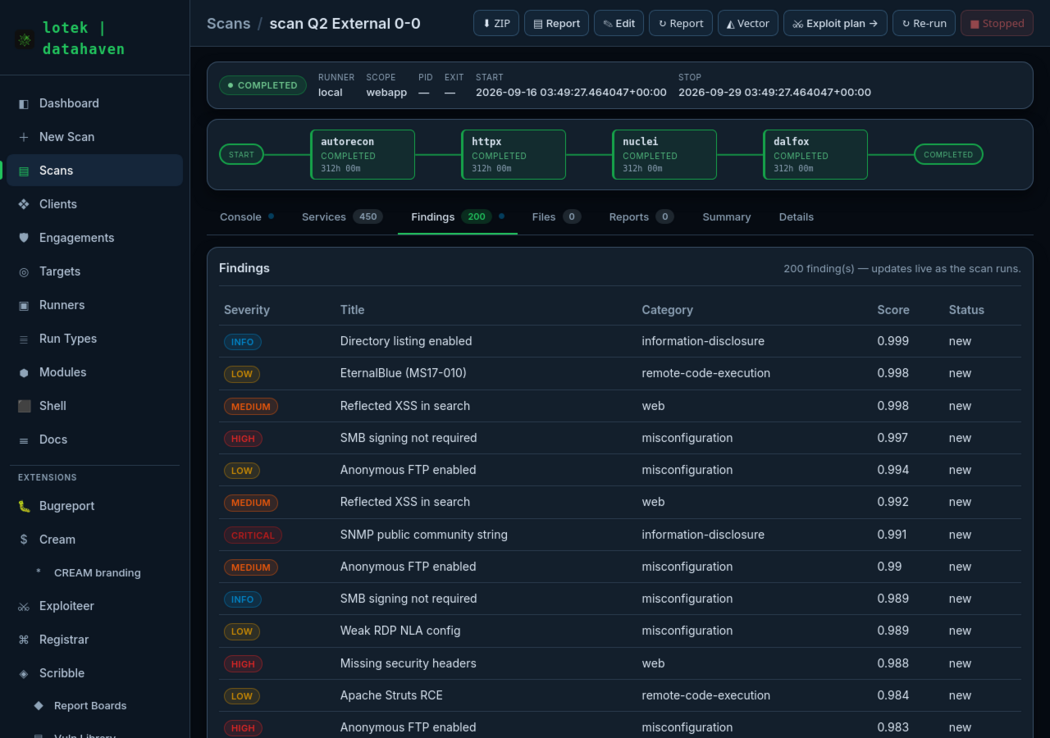
A scanner hands you hundreds of findings and leaves the triage to you. We do the triage. We rank the paths that are genuinely exploitable in your environment, scored against known-exploited vulnerabilities (KEV), likelihood (EPSS), and available exploit code, and we back each rank with the evidence that earned it. What you get is a short, ordered list of what to fix first, not a spreadsheet to argue with.
How a breach would unfold
We show you the whole path, from first foothold to your crown jewels.
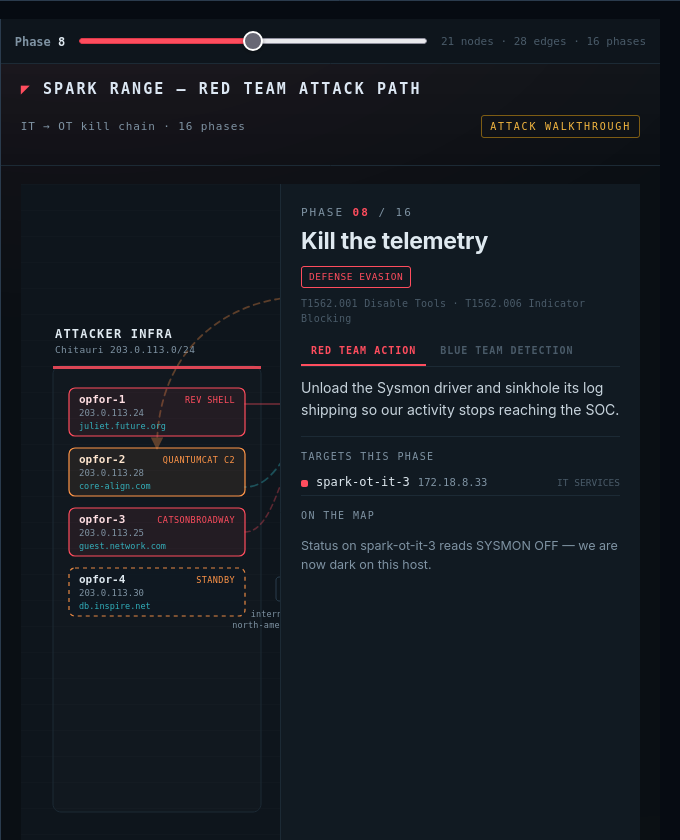
The diagram here is what attack-path output looks like. Use the replay to walk through a simulated engagement one step at a time: recon, content discovery, initial foothold, privilege escalation, lateral movement, and the reach to the crown jewels.
On a real engagement, your defenders get the exact chain so they can find the cheapest place to cut it. On a sustained campaign, we also record what your tools and team saw at each step and what slipped past. The realistic example above walks one such path start to finish.
How we work
One expert on your engagement, and a platform they built.
Someone who builds their own tools understands the process underneath them, and that is who you want on your network. We are deliberately neither an autonomous platform you point and forget, nor a rented crowd your test gets passed around. One experienced person owns your engagement start to finish. The open tools everyone uses are only as good as the hand on them. You are hiring the hand.
- Accountable, not outsourced. One US-based operator owns your test start to finish. The name on the report did the work.
- Point-in-time or sustained. A test of what is exploitable now, or a campaign that adapts over weeks and months. We run both.
- Judgment a scanner can't give. A person finds the business-logic abuse and the chained path that only works in your environment.
- Process over any one tool. nmap, Nuclei, BloodHound, Responder: in the kit because they work. Every result is proven the same way.
- Our own first client. We test our own systems before we test yours. The methodology was proven on us first.
- Your data stays with us. We run your engagement on our own infrastructure. Your findings and evidence are not shipped off to a third party.
Our tooling is built with AI, but what earns your trust is discipline: work that is tested, independently reviewed, and reproducible. We would rather under-claim and be right than over-claim and be caught. Our operators' names are on the report, so it is their reputation on the line.
Work with us
If this is the kind of test you want run on your network, let's talk.
We built this platform, and the people who built it run your engagement. If you want offensive security work done by people who take the work and your data seriously, reach out. Tell us what you need tested and we will tell you how we would approach it.